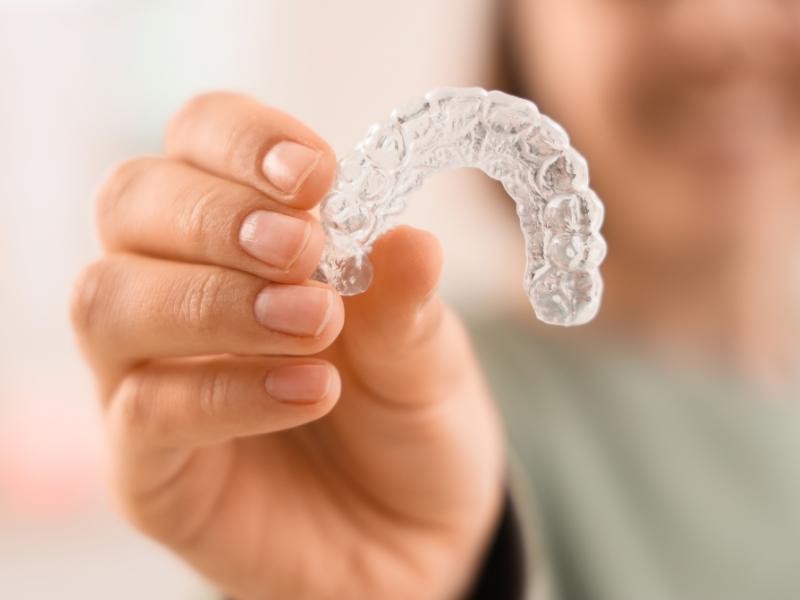
The invisible aligners have become one of the most sought after solutions in modern orthodontics, offering discretion, comfort and digital technology for those who want to align the smile without resorting to traditional metal appliances.
One of the most frequent questions among patients is: after all, how long does a treatment with invisible aligners last?
The answer depends on several factors, including the complexity of the case, the type of dental movement needed and the collaboration of the patient throughout the treatment.
At Alora Clínic , in Ramada, Odivelas, Lisbon, we use digital technology and personalized orthodontic planning to provide more predictable, comfortable and efficient treatments.
1. How long does a treatment with invisible aligners last on average?
On average, treatment with invisible aligners can last between 6 and 24 months, depending on the complexity of the clinical case.
Simpler cases, such as small misalignments, can be resolved in less time.
More complex situations, involving bite changes or greater movements, may require a longer period.
2. Does the treatment time vary from person to person?
Sim. Each smile has unique characteristics, so the duration of treatment varies according to each patient.
Among the influencing factors stand out:
- degree of dental misalignment;
- type of bite;
- age of the patient;
- biological response to tooth movement;
- discipline in the use of aligners;
- complexity of orthodontic planning.
3. What factors influence the time of treatment?
The timing of treatment with invisible aligners depends on several clinical and behavioral factors.
Among the main factors are:
- case complexity;
- necessary dental movements;
- correct use of aligners;
- compliance with scheduled exchanges;
- regular orthodontic follow-up;
- individual response of the organism.
Adequate digital orthodontic planning helps increase treatment predictability.
4. Is it possible to speed up the treatment with invisible aligners?
In some cases, it is possible to optimize the treatment, but always respecting the biological limits of the organism.
Some attitudes help to avoid delays:
- use aligners for the recommended time;
- perform plate changes correctly;
- attend follow-up consultations;
- follow all clinical guidelines.
The goal is to achieve predictable results without compromising oral health.
5. Is the treatment with invisible aligners faster than the fixed device?
In many cases, yes.
Thanks to digital planning, invisible aligners allow for more organized and predictable movements, especially in mild and moderate cases.
In addition, treatment tends to be more comfortable and integrated with the patient's routine.
6. How many hours per day should I use invisible aligners?
For the treatment to work properly, aligners should be used between 20 and 22 hours per day.
They should be removed only:
- during meals;
- for oral hygiene;
- when consuming drinks other than water.
Improper use can compromise results and prolong treatment time.
7. What happens if the aligners are not used correctly?
When aligners are not used as directed, dental movement stops following the intended planning.
This can cause:
- delays in treatment;
- need new aligners;
- additional adjustments;
- prolongation of the total treatment time.
The collaboration of the patient is essential to achieve the expected results.
8. Is the treatment time the same for simple and complex cases?
No.
Simple cases, such as small gaps or slight misalignments, tend to be faster.
More complex situations, such as major changes in the bite, may require more time and prolonged follow-up.
Digital planning makes it possible to evaluate each case individually and estimate the duration of treatment with greater precision.
9. When do the first results start to appear?
Many patients begin to notice visible changes in the first weeks or months of treatment.
However, the speed of changes depends on factors such as:
- case complexity;
- time of daily use;
- individual biological response;
- type of dental movement.
Orthodontic monitoring allows you to monitor the evolution and adjust the treatment when necessary.
10. Is it possible to predict exactly how long the treatment will last?
Sim. One of the great advantages of digital orthodontics is precisely the predictability of treatment.
Using:
- intraoral scan;
- virtual planning;
- 3D digital simulation;
- custom orthodontic analysis;
it becomes possible to estimate more precisely how long the treatment may last.
However, compliance with the plan also depends on the collaboration of the patient.
11. After treatment, is it necessary to use restraint?
Yes. After finishing treatment with invisible aligners, it is essential to use restraints to keep the teeth in the correct position.
Teeth have a natural tendency to partially return to their original position, especially in the first months after treatment.
Depending on the case, containment can be:
- removable;
- fixed;
- used only during the night after a certain period.
12. Where to carry out treatment with invisible aligners?
The treatment should be carried out in a clinic with experience in digital orthodontics, personalized planning and continuous monitoring.
At Alora Clínic , in Ramada, Odivelas, Lisbon, we use intraoral scanning, digital planning and personalized orthodontic monitoring to provide more predictable, comfortable and efficient treatments.
13. Conclusion
The duration of a treatment with invisible aligners varies according to the clinical needs of each patient, and can last from a few months to about two years in more complex cases.
Thanks to digital orthodontics, it is possible to plan treatment with greater precision, follow the evolution of the smile and offer a more comfortable and predictable experience.
At Alora Clínic , in Ramada, Odivelas, Lisbon, we offer personalized orthodontic treatments with digital technology and individualized monitoring.
If you want to know more about invisible aligners or understand the estimated duration for your case, you can schedule an evaluation consultation with our team.