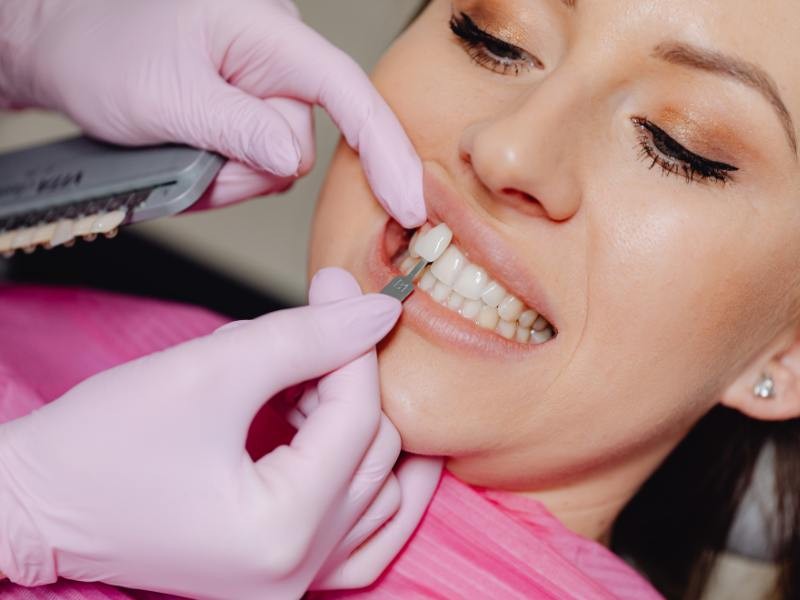
Dental aesthetics has evolved significantly in recent decades, allowing smiles to be transformed in an increasingly natural, conservative and personalized way.
Among the most sought-after aesthetic treatments currently stand out dental contact lenses and ceramic veneers .
Although they are often confused, there are important differences between these two aesthetic solutions.
Both use ceramic structures to improve the appearance of teeth, but have different indications, thicknesses and clinical approaches.
At Alora Clínic , in Ramada, Odivelas, Lisbon, we carry out personalized aesthetic treatments with advanced digital planning, respecting the facial harmony and the individual characteristics of each patient.
1. What are dental contact lenses?
The dental contact lenses are ultra-thin ceramic laminates applied to the front surface of the teeth.
The name appears due to its extremely reduced thickness, similar to the concept of eye contact lenses.
These pieces allow improvement:
- tooth color;
- form;
- symmetry;
- smile harmony;
- small misalignments.
2. What are ceramic facets?
The ceramic veneers are also porcelain structures used to improve dental aesthetics.
However, they usually have greater thickness compared to dental contact lenses.
This makes it possible to correct more significant aesthetic changes, including:
- very dark teeth;
- accentuated abrasions;
- fractures;
- changes more extensively;
- more complex aesthetic rehabilitations.
3. What is the main difference between lenses and facets?
The main difference is related to:
- thickness;
- clinical indication;
- amount of dental structure involved.
Dental contact lenses are thinner and more conservative, while ceramic veneers have greater thickness and can allow wider corrections.
4. What is the thickness of dental contact lenses?
Dental contact lenses usually have a thickness between:
- 0.2 mm and 0.5 mm.
This feature allows for more minimally invasive treatments, often with reduced or no tooth wear.
5. What is the thickness of the ceramic facets?
Ceramic veneers tend to have a higher average thickness, often close to:
- 1 mm.
This makes it possible to modify more significantly:
- color;
- volume;
- form;
- dental structure.
6. Do lenses preserve more tooth structure?
In many cases, yes.
Because they are extremely thin, dental contact lenses may require less wear on natural teeth.
This makes treatment more conservative in appropriate situations.
7. When are dental contact lenses indicated?
Lenses can be indicated in cases of:
- small changes in color;
- slight misalignments;
- diastemas;
- small irregularities;
- subtle aesthetic improvement;
- smile harmonization.
The indication always depends on the individual clinical evaluation.
8. When can ceramic facets be more indicated?
Facets can be indicated in situations that require greater aesthetic or structural correction, including:
- very dark teeth;
- fractures;
- severe wear and tear;
- more significant changes in shape;
- more extensive aesthetic rehabilitation.
9. Which of the options is better?
There is no universal answer.
The best option depends on several factors, including:
- dental structure;
- tooth color;
- bite;
- aesthetic objective;
- oral health;
- facial harmony.
In some cases, there may even be a combination of lenses and veneers in the same treatment.
10. Do lenses and facets look natural?
Sim.
When properly planned, both manage to provide extremely natural results.
Modern ceramic materials reproduce:
- translucency;
- texture;
- shine;
- natural features of teeth.
The goal is to create a harmonious and balanced smile, without artificial appearance.
11. Are lenses and facets resistant?
Sim.
The current ceramic materials have high strength and aesthetic stability.
However, some habits can increase the risk of fractures, including:
- bruxism;
- nail biting;
- biting objects;
- trauma.
Regular monitoring helps preserve the longevity of the treatment.
12. What is the durability of lenses and facets?
Durability depends on several factors, including:
- quality of materials;
- oral hygiene care;
- patient habits;
- bruxism;
- clinical maintenance.
With proper follow-up, both treatments can have long durability.
13. Do lenses and facets stain?
Ceramic materials have high stain resistance compared to natural enamel.
Even so, the maintenance of oral hygiene remains essential to preserve the aesthetic result.
14. How is smile planning done?
Currently, aesthetic planning is often carried out with advanced digital technology.
Among the resources used are:
- intraoral scan;
- clinical photography;
- digital smile design;
- aesthetic simulation;
- facial planning.
This allows you to create more personalized, predictable and harmonious treatments.
15. Who can perform these treatments?
Before any aesthetic procedure, it is essential to carry out a complete clinical evaluation.
Teeth and gums need to be healthy.
Problems such as:
- caries;
- periodontal disease;
- gingival inflammation;
- extensive fractures;
- functional changes.
must be evaluated beforehand.
16. Why is the choice of professional important?
The aesthetic and functional success of the treatment directly depends on:
- correct diagnosis;
- proper planning;
- clinical experience;
- facial harmonization;
- technical execution.
A detailed assessment is essential to define the best approach for each smile.
17. Where to carry out dental aesthetic treatment?
The ideal is to look for a clinic with experience in dental aesthetics, digital planning and a personalized approach.
At Alora Clínic , in Ramada, Odivelas, Lisbon, we carry out personalized aesthetic treatments with advanced digital technology, intraoral scanning and individualized smile planning.
18. Conclusion
Dental contact lenses and ceramic veneers are modern treatments of aesthetic dentistry, capable of transforming the smile in a natural and harmonious way.
Despite being similar, they have important differences related to:
- thickness;
- clinical indication;
- level of aesthetic correction;
- conservative approach.
The choice of the best option always depends on a personalized evaluation, considering dental characteristics, aesthetic objectives and facial harmony.
Thanks to digital technology and modern ceramic materials, it is possible to achieve increasingly natural, resistant and predictable results.
At Alora Clínic , in Ramada, Odivelas, Lisbon, we offer personalized aesthetic treatments with specialized support and modern technology.
If you want to improve your smile with dental contact lenses or ceramic veneers, you can schedule an evaluation consultation with our team.