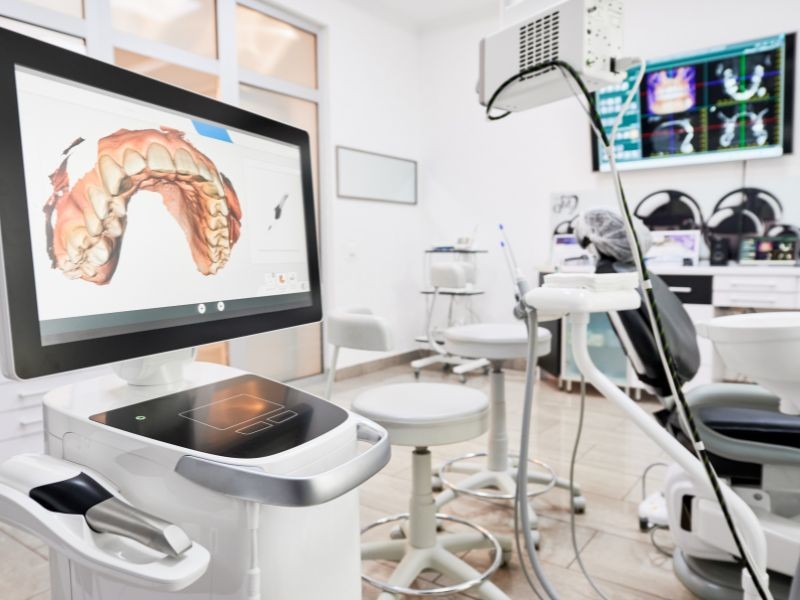
Technological evolution has profoundly transformed modern dental medicine, making treatments more accurate, fast, comfortable and predictable.
In this context, digital dentistry represents a true revolution in oral health care, providing a more modern experience for both patients and professionals.
Thanks to digital technologies, it has become possible to plan treatments with a high level of precision, reduce discomfort and significantly improve clinical and aesthetic results.
At Alora Clínic , in Ramada, Odivelas, Lisbon, we use advanced digital technology to provide more efficient, personalized and comfortable treatments.
1. What is digital dentistry?
digital dentistry is a modern approach to dentistry that uses digital technologies for diagnosis, planning and execution of treatments.
This approach replaces many traditional methods, allowing for more precise and predictable procedures.
Among the resources used stand out:
- intraoral scan;
- digital radiography;
- CT scan;
- 3D digital planning;
- 3D printing;
- CAD/CAM technology.
2. How does digital dentistry work?
Digital dentistry begins with the capture of digital images of the patient's oral cavity.
Using modern intraoral scanners, it is possible to create highly accurate three-dimensional digital models.
These images are processed by specialized software, allowing:
- more accurate diagnosis;
- personalized digital planning;
- simulation of treatments;
- production of prostheses and aligners;
- greater clinical predictability.
This allows faster, more comfortable and efficient treatments.
3. What are the advantages of digital dentistry?
Digital dentistry offers several benefits for patients and professionals.
- greater precision in treatments;
- more comfort for the patient;
- reduction of treatment time;
- more predictable planning;
- better clinical communication;
- less invasive procedures;
- more accurate aesthetic results;
- greater customization of treatments.
In addition, digital technology significantly improves the patient experience during consultations.
4. Why is digital dentistry more comfortable?
One of the great advantages of digital dentistry is the elimination of many traditional uncomfortable procedures.
For example, intraoral scanning often replaces casts with traditional masses, which could cause discomfort or vomiting reflex.
This provides:
- more comfort;
- less anxiety;
- faster consultations;
- best clinical experience.
5. What technologies are used in digital dentistry?
Digital dentistry integrates several advanced technologies.
Among the main ones are:
- intraoral scanners;
- digital radiography;
- 3D computed tomography;
- CAD/CAM software;
- digital smile planning;
- 3D printing;
- guided surgery;
- digital transparent aligners.
These technologies allow highly personalized and precise treatments.
6. What is intraoral scanning?
Intraoral scanning is a technology that allows to capture digital images of the patient's mouth through a high-precision scanner.
The equipment creates a three-dimensional digital model of the teeth and gums, often eliminating the need for traditional moldings.
Among the advantages stand out:
- more comfort;
- greater accuracy;
- speed;
- better adaptation of prostheses and aligners.
7. What is CAD/CAM technology?
CAD/CAM technology is a digital system used to design and manufacture dental restorations.
CAD stands for Computer-Aided Design and CAM stands for Computer-Aided Manufacturing .
This technology allows you to create:
- dental crowns;
- facets;
- dentures;
- custom structures.
The process is extremely precise and efficient.
8. Who is digital dentistry indicated for?
Digital dentistry can benefit patients of different ages and clinical needs.
It is indicated for:
- orthodontics;
- implantology;
- oral rehabilitation;
- dentures;
- facets;
- aesthetic smile planning;
- guided surgeries;
- Preventive treatments.
Clinical evaluation helps to define which technologies are most appropriate for each case.
9. Is digital dentistry faster?
Sim.
Digital integration significantly reduces several stages of treatment.
This allows:
- faster diagnoses;
- fewer consultations;
- more efficient production of prostheses;
- more predictable treatments;
- greater clinical agility.
In some cases, it is possible to carry out rehabilitation in much less time compared to traditional methods.
10. Does digital dentistry improve aesthetic results?
Sim.
Digital planning allows you to visualize and adjust aesthetic details with high precision.
This contributes to:
- more harmonious smiles;
- better adaptation of prostheses;
- more natural results;
- greater aesthetic predictability.
Digital technology allows you to customize treatments according to the characteristics of each patient.
11. Is digital dentistry safe?
Sim.
Digital dentistry is widely used in modern clinics around the world.
Digital technologies allow:
- more accurate diagnoses;
- greater clinical control;
- reduction of errors;
- more predictability;
- personalized treatments.
This significantly increases the safety and quality of treatments.
12. Does digital dentistry completely replace traditional methods?
Digital technology complements and improves many traditional procedures, but each case must be evaluated individually.
The most important thing is to combine:
- clinical experience;
- technical knowledge;
- modern technology;
- custom planning.
The goal is always to provide safer and more effective treatments.
13. Where to carry out treatments with digital dental medicine?
The ideal is to look for a clinic equipped with modern technology, experience in digital planning and personalized follow-up.
At Alora Clínic , in Ramada, Odivelas, Lisbon, we use advanced digital technology to provide more comfortable, accurate and accurate treatments foreseeable.
14. Conclusion
digital dentistry revolutionized the way dental treatments are planned and performed.
Thanks to modern technologies, it has become possible to offer treatments:
- more precise;
- faster;
- more comfortable;
- more personalized;
- most predictable.
Intraoral scanning, digital planning and CAD/CAM technology have significantly transformed patient experience and clinical outcomes.
At Alora Clínic , in Ramada, Odivelas, Lisbon, we offer modern treatments with digital technology advanced and personalized accompaniment.
If you want to know better the advantages of digital dentistry or make a personalized assessment, you can schedule a consultation with our team.