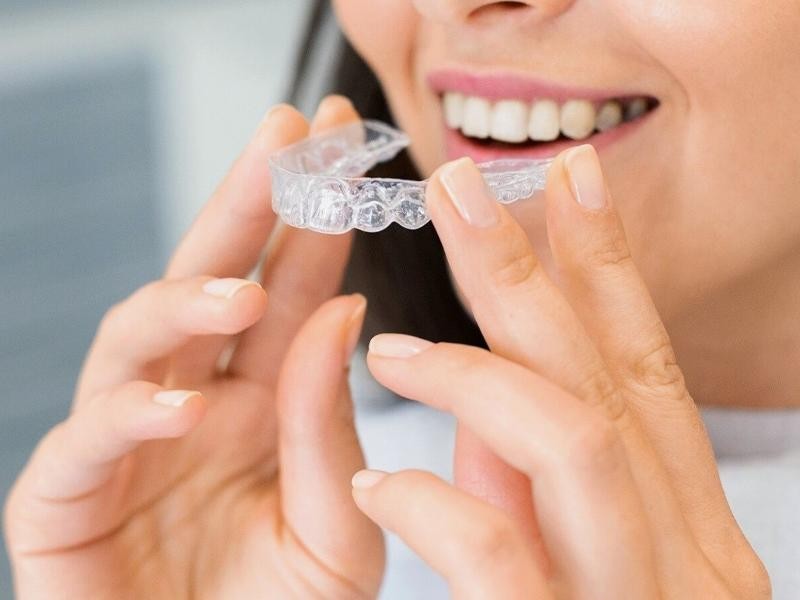
The invisible aligners have transformed the way teeth are aligned, combining aesthetics, comfort and technology in a discreet and personalized treatment. It is natural that doubts arise about how the process works and what to expect at each stage.
At Alora Clínic , in Ramada, Odivelas, Lisbon, invisible aligners are part of a modern approach to digital dentistry, with personalized planning and continuous monitoring throughout the treatment.
1. How does the treatment with invisible aligners work from start to finish?
Treatment with invisible aligners was developed to be organized, predictable and comfortable from the first consultation to the final phase.
It all starts with a detailed clinical evaluation, in which the dentist analyzes the patient's oral health, dental positioning and goals.
After this phase, a digital planning is carried out that allows you to visualize each stage of dental movement.
The process includes:
- personalized clinical evaluation;
- digital smile planning;
- personalized production of invisible aligners;
- scheduled aligner changes;
- regular follow-up visits;
- containment phase after treatment.
Throughout the entire process, the patient follows the evolution of the smile in a clear and predictable way.
2. What to expect from the first weeks with invisible aligners?
The first weeks represent a natural period of adaptation. In the early days, it's common to feel a slight pressure on your teeth, especially after putting on a new aligner.
This sensation is considered normal and indicates that tooth movement is happening gradually.
During this initial phase, it is usual:
- feeling light and temporary pressure;
- gradually adapt to speech;
- create a routine for using aligners;
- perceive greater ease in removal for food and oral hygiene.
As the days go by, the use becomes more comfortable and natural.
3. How is the adaptation to invisible aligners on a day-to-day basis?
Adaptation to invisible aligners usually happens gradually. Because they are discreet and removable, they allow you to maintain the daily routine with few changes.
The patient can continue to work, participate in social events and maintain their usual habits with comfort and discretion.
Some important care includes:
- use the aligners for the recommended time;
- removing aligners during meals;
- maintain proper oral hygiene;
- properly sanitize the aligners;
- store the aligners in the appropriate case.
With the right professional guidance, invisible aligners easily integrate into everyday life.
4. Does treatment with invisible aligners cause pain?
A frequent question is whether the invisible aligners cause pain. In most cases, what the patient feels is a slight controlled pressure, mainly in the first days of use or after changing the aligner.
This sensation tends to diminish rapidly as the body adapts.
As aligners do not have wires or metal components, the risk of irritation or small lesions in the mouth is generally lower.
During treatment, there may be:
- light and temporary pressure;
- passenger discomfort;
- gradual adaptation to dental movements;
- greater comfort compared to traditional appliances.
5. How long does the treatment with invisible aligners last?
The duration of treatment with invisible aligners varies according to each case.
Factors such as the degree of dental misalignment, the complexity of the bite and the correct use of aligners directly influence the time required.
Digital planning allows to obtain a more accurate estimate of the duration of treatment.
Some influencing factors include:
- type of dental misalignment;
- consistency in the use of aligners;
- compliance with scheduled exchanges;
- individual biological response.
With proper monitoring and correct use, treatment tends to follow the intended schedule.
6. What happens after the end of treatment?
After the end of the treatment with invisible aligners , the containment phase begins, essential to maintain the dental alignment achieved.
At this stage, the dentist recommends the most appropriate type of containment for each patient.
The objective is to avoid unwanted movements and guarantee greater stability of the results.
This phase includes:
- use of custom restraints;
- specific guidelines for use;
- follow-up consultations;
- maintenance of oral hygiene care.
Following the recommendations correctly, the results tend to remain stable in the long term.
Conclusion
The invisible aligners represent a modern and discreet solution for dental alignment, offering comfort, predictability and integration with your daily routine.
From the digital planning to the final phase of containment, the treatment is developed in a personalized way and accompanied by qualified professionals.
The Alora Clínic , in Ramada, Odivelas, Lisbon, offers treatments with invisible aligners integrated in a modern approach of digital dentistry.
If you want to know more about invisible aligners and understand if this solution is right for you, you can schedule an evaluation consultation with our team.