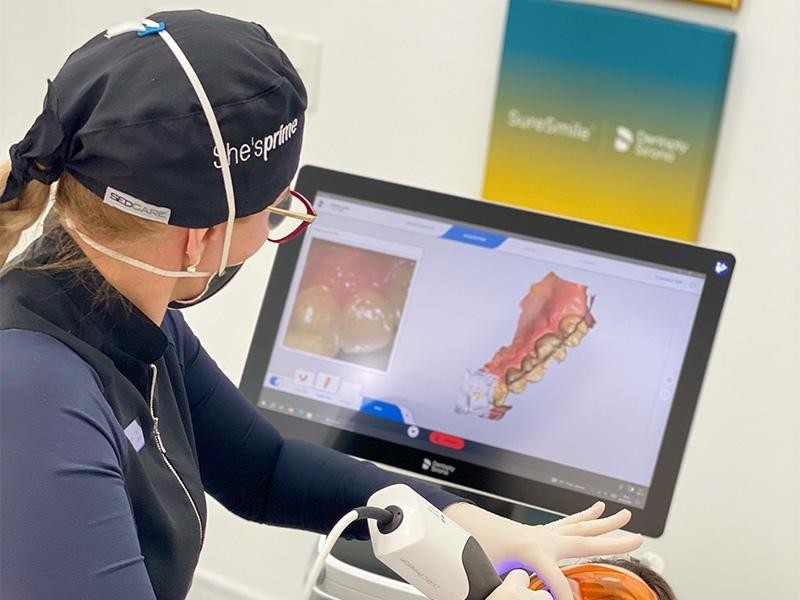
orthodontic monitoring with digital scanning represents an important advance of modern dental medicine, providing greater precision, comfort and predictability to orthodontic treatments.
With the support of digital technology, it became possible to plan, monitor and adjust each stage of treatment more efficiently and safely. Understanding the differential of this type of monitoring helps the patient understand how technology can contribute to a more comfortable experience and more predictable results.
At Alora Clínic , in Ramada, Odivelas, Lisbon, orthodontic monitoring with digital scanning integrates a modern and personalized approach to digital dentistry.
1. What is orthodontic monitoring with digital scanning?
orthodontic monitoring with digital scanning is an approach that uses digital technology to follow the evolution of orthodontic treatment more accurately and comfortably.
Through an intraoral scanner, the dentist obtains detailed digital images of the dental arches, without the need for traditional moldings.
These digital records allow:
- follow dental movement with precision;
- compare different phases of treatment;
- make custom adjustments;
- improve clinical control of treatment;
- increase predictability of results.
This technology makes orthodontic monitoring more efficient and aligned with the current standards of digital dentistry.
2. How does digital scanning work in orthodontic follow-up?
The digital scan is performed through an intraoral scanner capable of capturing detailed images of the teeth and dental arches quickly and comfortably.
During the consultation, the equipment runs through the patient's oral cavity, recording digital images that are transformed into a three-dimensional model.
Throughout the treatment, new scans may be performed for:
- follow the evolution of tooth movement;
- compare results between consultations;
- assess the need for adjustments;
- confirm if the treatment is following the defined planning.
This method allows for more organized and predictable monitoring.
3. What is the difference of orthodontic monitoring with digital scanning?
The main differential of orthodontic monitoring with digital scanning is in the accuracy of the information and the ability to monitor the treatment continuously.
Compared to traditional methods, digital scanning allows a more detailed control of tooth movement and reduces limitations associated with conventional moldings.
Among the main differentials stand out:
- higher fidelity of digital images;
- more comfort during consultations;
- reduction of the need for physical molds;
- continuous and comparative monitoring;
- greater predictability of treatment.
This approach allows for a more modern, organized and personalized orthodontic treatment.
4. What are the advantages of digital scanning in orthodontic follow-up?
Digital scanning brought important benefits for orthodontic monitoring, both for the professional and for the patient.
The use of digital records facilitates planning and improves monitoring accuracy.
Among the main advantages are:
- greater clinical accuracy;
- more comfort in consultations;
- clear visualization of the evolution of the treatment;
- comparison between different phases;
- more personalized adjustments;
- greater predictability of results.
These benefits contribute to a more comfortable and organized experience throughout orthodontic treatment.
5. Is orthodontic follow-up with digital scanning more accurate?
Yes. The orthodontic monitoring with digital scanning offers a higher level of accuracy compared to traditional methods.
The technology allows to reproduce in high detail the dental anatomy, facilitating the monitoring of changes between consultations.
Some factors that contribute to this greater precision include:
- detailed three-dimensional digital images;
- precise comparison between different phases;
- reduction of distortions associated with conventional moldings;
- more well-reasoned clinical decisions.
This precision allows for a more predictable and efficient treatment.
6. Does digital scanning allow you to visualize the evolution of the treatment?
Sim. One of the great advantages of digital scanning is the possibility to visualize the evolution of orthodontic treatment in a clear and objective way.
The digital records made during the consultations allow to compare different moments of the treatment, facilitating the analysis of dental movement.
This visualization helps:
- to monitor the progress of the treatment;
- to identify necessary adjustments;
- to improve communication between dentist and patient;
- to make the process more transparent and predictable.
The patient is able to follow the evolution of his own smile in a more clear and participatory way.
Conclusion
orthodontic monitoring with digital scanning has brought more precision, comfort and predictability to modern orthodontic treatments.
The use of digital technology allows a more detailed monitoring of dental evolution, favoring personalized adjustments and greater clinical control throughout the treatment.
At Alora Clínic , in Ramada, Odivelas, Lisbon, digital scanning integrates a modern approach to dental medicine, focused on technology, personalization and continuous monitoring.
If you want to know more about orthodontic monitoring with digital scanning, you can schedule an evaluation consultation with our team.